
Have you ever heard or read the expression “Low Code” and not really understood how it differs from traditional programming? Here we will explain everything!
In the modern corporate environment, the pace of digital transformation is relentless. Companies face what we call the “innovation gap”: the demand for new applications, process optimizations, and modernization of legacy systems massively exceeds the capacity of Information Technology (IT) teams to deliver them in a timely manner. If your development team’s backlog resembles the release queue of a new smartphone, long, impatient, and stagnant, you have a chronic Time-to-Market problem.
It is in this context that Low-Code establishes itself as a strategic catalyst. This methodology allows organizations to quickly adapt to market and customer expectations, promising the necessary agility without sacrificing the quality or customization that enterprise-level development requires. For Yasnitech, a partner of OutSystems (a global leader in this market), Low-Code is the pillar that transforms the IT department from an operational bottleneck into a strategic partner focused on generating value and innovating, including preparing the path for the next evolution of your business: Agentic Artificial Intelligence.
The Concept Behind “Low Code”
Low-Code represents a revolutionary approach to software development. At its core, Low-Code is a way to build platforms and applications using minimal programming language, or more precisely, minimizing the need for repetitive manual coding.
This accomplishment is made possible by tools known as LCAPs (Low-Code Application Platforms). LCAP platforms offer intuitive visual interfaces filled with pre-built components and templates that use drag-and-drop functionality. The Low-Code solution delivers foundational features that cover most business needs.
The major differentiator is its openness to traditional coding. It does not attempt to replace code, but rather to optimize it. When a business requirement demands a specificity that pre-built components cannot address, the platform allows for easy integration of custom code.
The goals of this methodology are:
Increase the productivity of professional developers:
- By automating the creation of basic and repetitive code, the platform allows developers to invest their time and creativity in the most complex aspects of development, focusing on innovation and the richness of the application’s feature set.
Multi-platform development capability:
- Low-Code platforms also ensure the ability to develop applications for different web environments, mobile, and responsive interfaces using a single technological base. This approach democratizes software development, allowing professionals from various areas to create complete solutions, including APIs and integrations, through intuitive interfaces and ready-to-use components. This accelerates value delivery and facilitates application adoption by end users.
By optimizing talent and standardizing foundational development, the Low-Code platform elevates the IT department, enabling it to shift resources away from merely resolving bottlenecks and toward more technical and customized projects. Effective management of developer time, focusing on solving complex problems, directly contributes to talent retention and the delivery of richer, more innovative features.
“Low-Code platforms have proven to be very efficient in ensuring governance and control in the daily management of our applications. With native versioning and monitoring of Logs and Traces in a single portal, we can provide reliable support while maintaining traceability of changes and compliance with our internal standards, all with lower technical complexity and greater autonomy for our business teams to continuously evolve the application.”
- Julio Mello, Product Owner at Yasnitech.
Organizations adopting Low-Code can build applications that would traditionally take months in approximately 4 to 12 weeks. The budget impact is clear: 62% of companies report greater control over application development budgets with Low-Code. This time and cost savings is not just an operational metric; it becomes a competitive advantage. The company gains the ability to act in three crucial areas: cost, quality, and, most importantly, Time-to-Market.
The Architecture of Low-Code: Modeling and Scalability
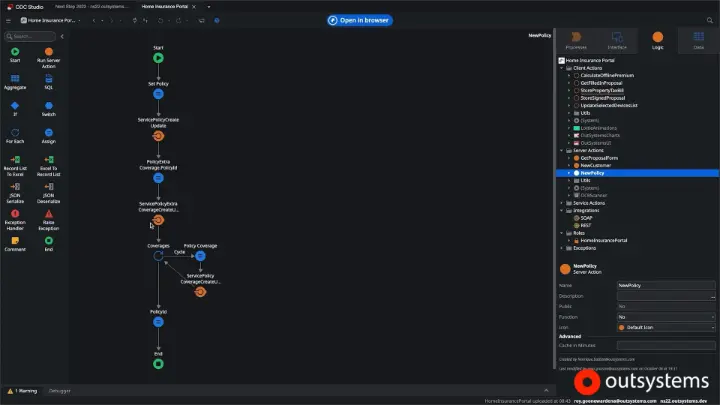
At the heart of Low-Code lies the promise of building logic, not just typing syntax. This is possible because Low-Code development occurs in a visual Integrated Development Environment (IDE), where the developer creates a graphical representation of the data model, business logic, and user interface (UI).
The architecture relies on modular components and pre-built templates. This approach simplifies the development process and accelerates solution creation, resulting in time and operational cost savings.
However, the deepest architectural advantage is its implicit governance. By guiding developers to follow a visual pattern and use standardized components within the IDE, the Low-Code architecture subtly enforces best software development practices.
For Low-Code to be effective at enterprise scale, it must be extensible, supporting scalability and cross-platform compatibility. Low-Code not only allows visual creation of flows but also supports the full software lifecycle (full lifecycle management), including end-to-end security and governance—both essential for mission-critical systems.
Additionally, the ability to add custom components opens up a wider range of implementations, enabling work with multiple platforms and, crucially, integration with legacy systems (the famous systems that still work, but no one dares to touch). That is why, for complex projects, Low-Code is the strategic balance: it offers visual standardization without the limitations of a closed system.
Where Does Low-Code Stand Out Compared to High-Code or No-Code?
For a development strategy to succeed, it is crucial to understand the dividing lines among the three main approaches: High-Code, No-Code, and Low-Code. Each has a target audience, supported complexity level, and ideal use cases.
High-Code
High-Code (traditional development) is the method of choice for large-scale, complex applications requiring the highest level of customization and highly specific API integrations. It requires developers with deep technical knowledge. While it offers full freedom, the downside is the high cost and long development cycle, which extends Time-to-Market.
No-Code
No-Code is targeted at non-technical business users, allowing them to create applications without writing a single line of code. It is ideal for rapid prototyping, simple front-ends, basic dashboards, or departmental task automation.
However, No-Code is inherently a closed system. Its extensibility is limited to pre-built templates and features, restricting its scalability, cross-platform compatibility, and ability to integrate with legacy systems. While fast, it often leads to the creation of “stopgap solutions” or “apps slower than your dial-up modem” that, if they grow in importance, will require a costly rewrite.
Low-Code
Low-Code positions itself at the ideal midpoint, balancing speed with customization and integration.
Low-Code is the ideal scenario for projects seeking complex workflow automation and scalable enterprise applications that require cross-platform capability and deep integration. Unlike No-Code, its architecture is designed for the enterprise level, enabling rapid prototypes to evolve into robust long-term systems without needing to discard and rebuild the work.
The ability to add custom code expands implementation options and ensures scalability that No-Code cannot provide.
The Agentic Revolution: Meet Agent Workbench
With OutSystems, You Easily Integrate and Build AI Agents Through Agent Workbench
Through its strategic partnership with OutSystems, Yasnitech offers the Agent Workbench—an AI-powered Low-Code solution designed to build and orchestrate AI agents ready for enterprise environments. The goal is to transform business processes into intelligent agentic systems more quickly, easily, and, most importantly, securely.
If you want to learn more about Agent Workbench, check out our article where we explain everything about this new AI model 👉 O Agent Workbench Chegou: A OutSystems acaba de adentrar no futuro da Inteligência Artificial para o mundo de desenvolvimento
YasNiTech and OutSystems
Yasnitech is proud to be a partner of OutSystems, the global leader in Low-Code platforms. This leadership is consistently recognized by major market analysis institutions. OutSystems has been named a Leader in the Gartner® Magic Quadrant™ for Enterprise Low-Code Application Platforms for the 9th consecutive year. More than just appearing in the quadrant, OutSystems was positioned highest on the “Ability to Execute” axis.
This validation in Gartner’s quadrant signals that the platform not only has a future-oriented vision (Innovation) but also delivers the robustness and quality in product and customer support (Execution) required for mission-critical systems in large organizations.
By choosing OutSystems, Yasnitech and its clients gain access to a unified platform designed for serious IT teams and complex use cases. The partnership provides a platform that supports the full software lifecycle and scales to meet the most demanding enterprise needs. This minimizes strategic risk for B2B clients, ensuring that their Low-Code investment is secure and adaptable.
About YasNiTech
Founded in 2013 by former IBM professionals, YasNiTech is a global technology company with offices in São Paulo, Boston (USA), and Sansepolcro (Italy). Since its inception, it has rapidly solidified itself in the Brazilian market by delivering innovative solutions in fraud prevention, loss prevention, and business analytics.
Over the years, the company has expanded its portfolio, incorporating initiatives in Low-Code platforms, process digitization, and automation. Among its innovations, it introduced to the Brazilian market the first Multi-Enterprise Business Process Digitalization tool, boosting digital collaboration across the supply chain.
In its current phase, YasNiTech positions itself at the forefront of Artificial Intelligence, with a special focus on Agentic AI. The company develops intelligent, autonomous solutions that enhance decision-making, operational efficiency, and innovation across multiple sectors of the economy, such as healthcare, pharmaceutical, logistics, and industrial sectors.