
Documentation in Agile Projects: Myth or Foundation?
There is much talk that agile methodologies dispense with documentation, but this is a dangerous myth. In reality, documentation is essential for sustainable agility, especially in scenarios with distributed teams, continuous delivery, and low-code platforms. It ensures continuous alignment and reduces rework. Without clear records, decisions and details remain confined to people’s memory, turning simple changes into major efforts. YasNiTech advocates that lightweight, traceable, and integrated documentation should permeate the entire lifecycle, from discovery to delivery, to maintain product quality, scalability, and evolution.
Alignment and Context
In every sprint, new requirements and hypotheses emerge. Documentation prevents communication noise by creating shared context, allowing any team member to resume work after a period of time.
Governance and Traceability
Decision histories and state transitions (e.g., in Azure DevOps: New → Active → Resolved → Closed) formally document the workflow. This preserves product integrity and facilitates internal audits.
Product Continuity
A well-documented product grows without breaking or depending on specific individuals. With clear materials, new developers onboard easily, and the product evolves without losing coherence.
Productivity and Automation
In low-code combined with AI, clear documentation drastically reduces the time to generate value. For example, the combination of agile, AI, and low-code reduced the “time to first value” from several days to just 10 minutes. AI interprets well-structured requirements, suggests improvements, and accelerates the entire SDLC; without documentation, it loses context.
In summary, documentation does not hinder agility, it enables it. It creates fertile ground for intelligent decision-making, effective collaboration, and robust governance.
Elements of User Story Mapping
User Story Mapping structures requirements in layers ranging from business to technical aspects. The table below summarizes each artifact, its purpose, and its working perspective:
Artifact | Purpouse | Language | Horizon |
Backbone | Narrative of user objectives | Problem / Objective | High level |
Epic | Major system capabilities | Product | Medium-high |
Feature | Specific system funcionality | Solution | Medium |
User Story | Minimum unit of value delivered to the user | Value | Short |
Task | Technical breakdown of a User Story into actions | Technical | Execution |
- Backbone (Spine): This is the high-level narrative flow of the user. It organizes the main activities (major tasks) in the order in which the user’s story unfolds. Jeff Patton emphasizes that the backbone gives structure to the map by arranging activities in a narrative sequence and “giving the story map its structure.” YasNiTech stresses that the backbone should not be confused with epics or features: it must be built exclusively from the user’s actions and objectives. In this way, the user’s “what” and “why” are captured first, before considering the technical “how.”
- Epics: These are the major system capabilities, emerging directly from the main blocks of the narrative. Each epic answers the question, “Which broad functionalities are necessary to support the user’s story?” Common examples include Login, Inventory Management, or Subscription Flow, which represent cohesive sets of high-level functionalities. Epics maintain the overall product vision and guide the identification of features.
- Features: These break each epic down into specific functional components. In the Login epic, for example, features may include user authentication, login attempt management, validation of authentication methods, and so on. Features make the epic more tangible by dividing it into still-large but functional pieces. They do not yet reach the level of minimum user value, but they facilitate initial technical planning.
- User Stories: These are the smallest unit of value delivered to the user. Each story describes who (persona), what they do (action), and why (benefit). The format used is “As a [persona], I want [action], so that [benefit].” Typical examples include:
- Tasks: These break each user story into executable technical actions. While the story defines what is to be delivered, tasks explain how the team will implement it. Each story also includes acceptance criteria (usually in BDD) and technical notes. In the lifecycle, unit tests validate the internal behavior of the code, and UAT tests (User Acceptance Tests) ensure that the end user receives exactly what was promised. Thus, tasks and tests close the loop: they bring the user story from paper to reality, ensuring quality.
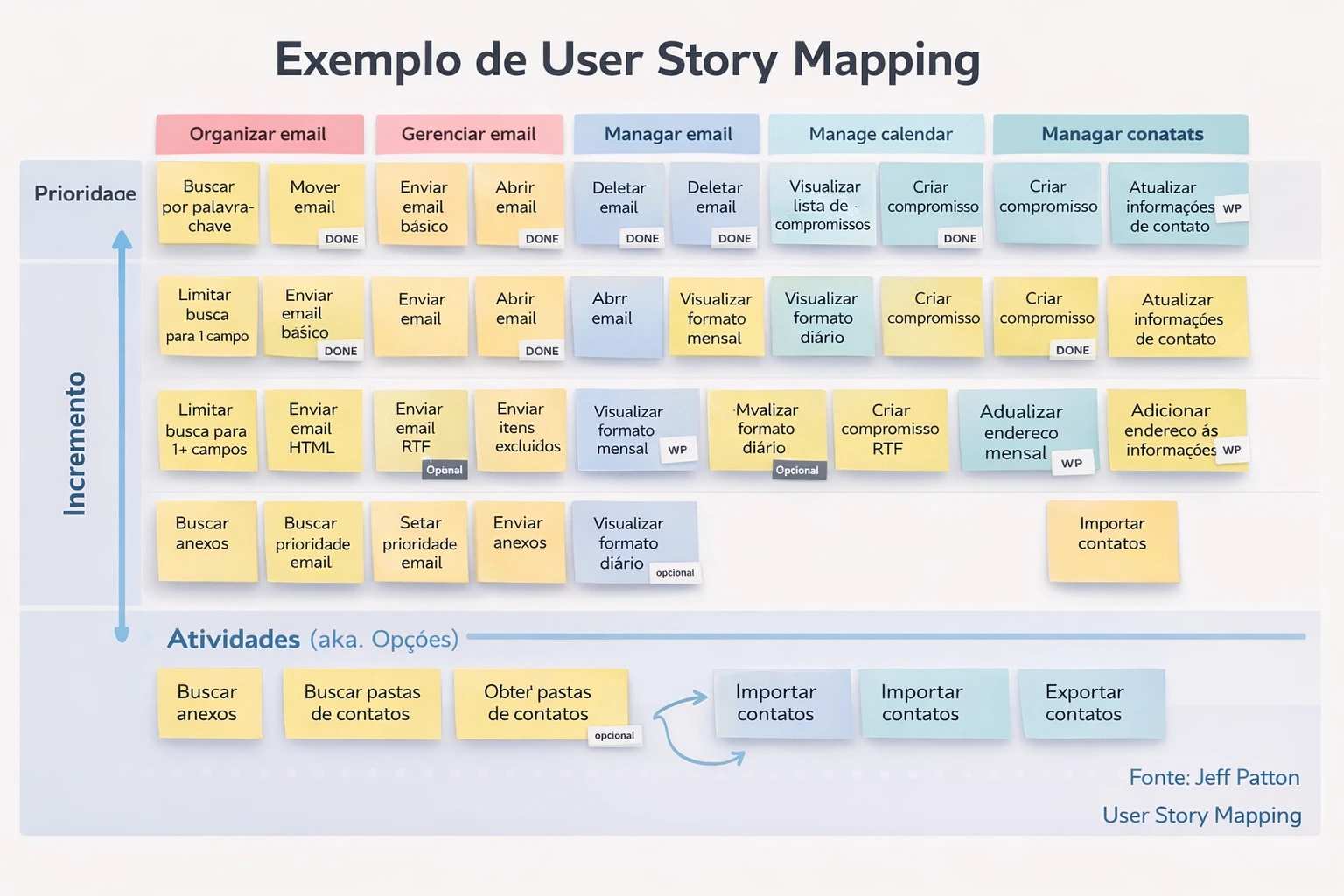
In the figure, a conceptual map can be observed: along the backbone (narrative flow), the user’s key activities are aligned, each subdivided into tasks and smaller stories. The sliced releases (at the bottom) show how incremental slices of the product are prioritized for delivery. This diagram exemplifies how User Story Mapping keeps the user at the center, organizing requirements in a visual and iterative way.
Documentation, Governance, and Quality
Agile documentation ensures governance, traceability, and quality throughout development. In tools such as Azure DevOps, each work item tells part of the story: state transitions (e.g., New → Active → Resolved → Closed) record progress, and the discussion area documents decisions and alignments. Tasks reveal the technical effort invested, while tests demonstrate code quality (unit tests) and the quality of the final system (UAT tests).
Parent/Child/Related relationships explain dependencies between functionalities, providing visibility into the impact of each component. Together, these artifacts form a “complete map of intent, effort, and outcome.” This clear and auditable record not only strengthens corporate governance but also enhances team productivity by facilitating onboarding and product maintenance.
In addition, documentation accelerates testing and automation. Well-defined acceptance criteria enable the creation of consistent automated tests. In low-code environments, clear requirements combined with AI make intelligent automation possible: AI mentoring tools interpret User Stories, suggest improvements, and assist with coding and testing tasks. In practice, with structured documentation, AI multiplies team productivity; without it, maintaining context and continuity is not feasible. The result is a faster feedback cycle with fewer errors, accelerating deliveries without sacrificing quality.
Best Practices for Agile Documentation
To prevent documentation from becoming a heavy burden, adopt principles that keep it lightweight, alive, and integrated into the workflow:
- Be clear, not verbose: write only what is essential. Prefer objective information that enables immediate understanding.
- Document for the next developer, not for an audit: focus on the internal team and the real context of use.
- Keep it up to date: nothing is worse than obsolete documentation. If something changes, immediately revise the artifacts (stories, technical notes, diagrams).
- Centralize information in one place: use Azure DevOps (or a similar tool) as the official single source of truth. This ensures everything is accessible and versioned.
- Include documentation in readiness and acceptance criteria: add documentation items to the Definition of Ready and Definition of Done. For example, only mark a story as done when its description, acceptance criteria, and technical notes are complete.
Adopting these habits makes documentation a natural part of the daily workflow, not an extra task. Over time, it stops being seen as bureaucracy and becomes the team’s way of operating.
Documentation Culture in Engineering
When the team internalizes the importance of documentation, it becomes part of the team’s DNA. As stated in the YasNiTech guide, “documentation ceases to be an additional effort; it becomes simply the natural way of working.” The consistent practice of documentation creates “fertile ground for intelligent automation” and faster collaboration. In other words, Agile does not replace documentation, Agile requires documentation to exist in a sustainable way.
Agile documents act as the link between business, design, engineering, testing, and support. When they are part of the team’s DNA, they become an invisible competitive advantage: they drive quality, scalability, and delivery pace without being perceived as a cost. In an increasingly dynamic world, maintaining lightweight, living documentation aligned with the methodology is the silent engine that sustains true agility.
About YasNiTech
Founded in 2013 by former IBM professionals, YasNiTech is a global technology company with offices in São Paulo, Boston (USA), and Sansepolcro (Italy). Since its inception, it has quickly established itself in the Brazilian market by delivering innovative solutions in fraud detection, loss prevention, and business analytics.
Over the years, the company has expanded its portfolio, incorporating initiatives in Low-Code platforms, digitization, and process automation. Among its innovations, it introduced the first Multi-Enterprise Business Process Digitalization tool to the Brazilian market, boosting digital collaboration within the supply chain.
Inits current phase, YasNiTech positions itself at the forefront of Artificial Intelligence, with a special focus on Agentic AI. The company develops intelligent and autonomous solutions that enhance decision-making, operational efficiency, and innovation across multiple sectors of the economy, such as healthcare, pharmaceuticals, logistics, and industry.